
How Laayo makes money
A plain explanation of our revenue lines, from restaurant commission and delivery fees to memberships and software for businesses, and why we built them in this order.

People often ask how a delivery app in a smaller town can be a real business. It is a fair question. Margins in delivery are thin everywhere, and the economics only work if every part of the system pulls its weight.
This post explains, in plain terms, where Laayo’s revenue comes from today and how the lines fit together. We do not share figures here. What we want to show is the shape of the business.
1. Restaurant and shop commission#
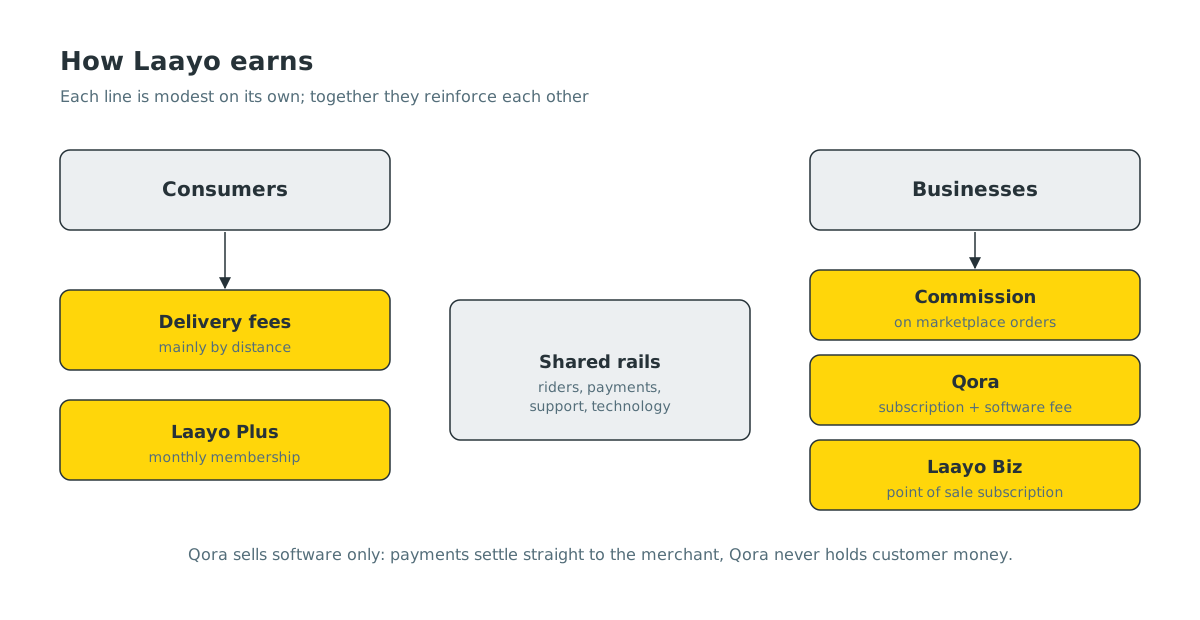
When a customer orders through Laayo, the restaurant or shop pays us a commission on the order. This is the core of most delivery businesses and it is the core of ours.
In return, partners get things that would be hard or expensive to build alone: new customers who would never have called them, a rider fleet they do not have to hire, an app to manage their menu and orders, E-Payment collection, and regular payouts with a full statement of every order, fee and adjustment.
We keep the deal simple. A partner should be able to understand exactly what they paid for any order by reading their statement. Clear money builds trust, and trust keeps partners with us.
2. Delivery fees#
Customers pay a delivery fee that depends mainly on distance. Delivery fees help cover what it costs to get food from the kitchen to the door, most importantly what we pay riders.
We think of delivery fees as a lever, not just a charge. Lower fees on short trips encourage people to order more often. Free delivery is one of the main benefits of membership. And in bad weather a small rain charge helps make sure riders are paid fairly for harder trips.
3. Laayo Plus#
Laayo Plus is our membership. Members pay a monthly fee and get free delivery on a set number of qualifying orders each month, priority support and other perks.
Memberships matter to us for two reasons. They create steady, recurring revenue that does not depend on any single order. And they change behaviour: members tend to make Laayo their default, which makes every other part of the business stronger.
4. Qora: software for payments#
Qora is a QR payment platform for Nepali businesses. Merchants use it to create dynamic QR codes, see payments arrive in real time and connect payments to their own systems through an API.
Qora earns a subscription and a small per-transaction software fee, drawn from a prepaid credit balance. One detail matters a lot: Qora never holds customer money. Payments settle directly to the merchant through their own payment account. We sell software, not custody, which keeps the model simple and the risk low.
5. Laayo Biz: point of sale for restaurants#
Laayo Biz is a point of sale and restaurant management system that runs in the browser and on a phone or tablet. Restaurants use it for billing, tables, kitchen order tickets, staff and reports. Each business gets its own separate, isolated data.
Laayo Biz is a subscription. It also connects to the Laayo marketplace, so orders that arrive through the app can flow straight into the restaurant’s point of sale. For a partner, that means one place to see everything. For us, it means a deeper, longer relationship with every restaurant that uses both.
Why this order#
We did not build all of these at once, and the order was deliberate.
Delivery came first because it is the service people use most often and it builds the networks everything else depends on: customers, partners, riders and payments.
Membership came next because once people order regularly, a membership turns occasional customers into loyal ones and adds revenue that repeats every month.
Software for businesses came after because by then we already had relationships with restaurants and shops, and we had already built the payment and operations tools for our own use. Turning those tools into products was a natural step. A restaurant that uses Laayo for delivery, Laayo Biz for its counter and Qora for payments is a restaurant with every reason to stay.
What we will not do#
Some ways of making money would hurt the business we want to build, so we avoid them.
- We do not hide fees. Customers see delivery fees and charges before they order. Partners see every deduction on their statement.
- We do not hold other people’s money longer than we need to. Partners are paid on a regular schedule, and Qora does not hold customer funds at all.
- We do not buy growth with discounts we cannot sustain. Offers are useful, but a business that only works when it pays people to use it is not a business.
The shape of the opportunity#
Each line on its own is modest. Together they reinforce each other. Delivery brings customers and partners. Membership keeps customers. Software keeps partners. Payments run underneath all of it.
That combination is what we think makes Laayo different from a delivery app alone, and why we believe a business built in smaller towns can be a strong one. You can read more about how the products connect in one company, four products.


