
How riders earn at Laayo, and why the number on the card is the number you get
Laayo riders work in two ways, on a salary or as freelancers. Here is how each one is paid, how tips stay with the rider, and why we care so much that the promise on an order matches the pay.

Every Laayo order ends with a rider at a gate, a bag in hand, sometimes in the rain, often in the lunch rush. Nothing we build matters if that person does not trust how they are paid. So this post is about money, rider money, and the rules we hold ourselves to.
Two ways to ride with Laayo#
Riders join Laayo in one of two ways.
Salaried riders work set shifts and earn a monthly salary. They carry the same app and take the same orders, but their pay does not depend on how many trips they finish in a day. For riders who want a steady income, this is the simpler choice.
Freelance riders choose when they work. They book gigs, which are time slots in their area, go online when the gig starts, and are paid for each delivery they complete. For riders who want flexibility, or who ride alongside studies or another job, this is the better fit.
Both groups are part of the same team. They use the same app, see the same orders and get the same support. What changes is how the pay is worked out.
What a freelance rider earns on an order#
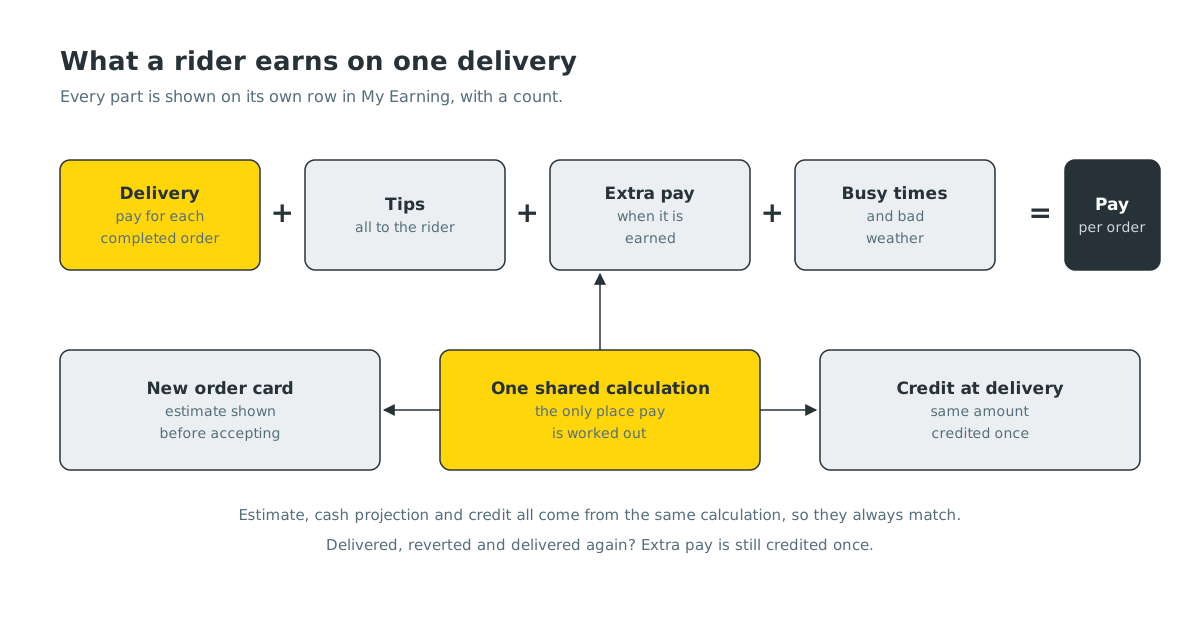
For a freelance rider, the pay for a single delivery is built from a few clear parts:
- Trip pay. This comes from the delivery fee on the order, after Laayo’s share. It is the base of every delivery.
- Tips. Whatever the customer chooses to tip goes to the rider in full.
- Gig incentives. Riders who are on a booked gig can unlock extra pay by reaching trip milestones during the day.
- Surge. At busy times, and when it rains, some deliveries carry extra pay on top.
- Long distance return pay. On long trips, where the ride back is far, an extra amount can apply for the return leg.
The promise on the card#
When a new order arrives, the rider sees a card with the pickup, the drop and an earnings estimate. That estimate is a promise. If a rider accepts an order because it says one amount and is credited a different amount later, they will stop believing the card, and they will be right to.
Earlier this year we found cases where the estimate and the final credit did not agree. Return pay was worked out from a different distance in two places. A trip incentive was counted one delivery late. A free-delivery order was handled differently in the preview than at delivery. None of these were large on their own, but each one chipped away at trust.
The fix was a rule, not a patch. Every part of a freelance rider’s pay is now worked out by one shared calculation, and that same calculation feeds three places:
- the earnings estimate on the new order card,
- the projection of cash the rider will hold after the order,
- the amount actually credited when the order is delivered.
If anyone on our team adds a new kind of pay in future, it has to go through that one calculation. It cannot be worked out separately in two places, because that is exactly how the numbers drift apart.
We also made the credit safe to repeat. If an order is marked delivered, reverted and marked delivered again, incentives and surge are credited once, not twice.
Seeing your earnings#
Riders asked for a clearer picture of where their money comes from, so the My Earning screen was rebuilt around three simple views: Day, Week and Month.
- Arrows let you move back through past days, weeks and months.
- A bar chart shows how each day went.
- You see how many orders you delivered and how long you spent on orders.
- Each kind of pay, order earnings, tips, incentives and surge, has its own row, and tapping a row shows how many times it applied.
The totals on this screen are checked against the same records the credits come from, so the chart, the rows and the total always add up to the same figure.
Tips belong to the rider#
A tip is a thank you from a customer to one specific person. We think it should be treated that way.
Riders can open a Customer tips screen that lists each tip they received: which store, which order, which day and how much. No guessing about where a tip went.
We are also rolling out a protected tip balance. With it, tips are kept in their own pot, separate from the rest of a rider’s wallet. Nothing else can be deducted from that pot, tips can be withdrawn on their own, and any tips left in it are transferred out automatically every week. It turns on once the new rider app is in everyone’s hands, so that no tip ever lands somewhere a rider cannot see it.
Fuel, without the paperwork#
Salaried riders often pay for fuel from the cash they collect on the road. Keeping track of that used to mean paper receipts and a conversation at the end of the week.
We are rolling out Request fuel in the rider app. The rider takes a photo of the petrol receipt, the app reads the total for them, and they confirm the amount. That amount is recorded straight away against the cash they are holding, and it shows up in their statement as fuel. If the photo cannot be read, or the amount looks unusual for the distance ridden since the last fill, it is simply marked for a quick review by our team. The rider is never left waiting for an approval to keep riding.
Payouts that need the right details#
Freelance riders withdraw their earnings to their own bank account. To keep that safe for everyone, payouts need a verified PAN and bank account first. Riders submit these once in the app, our team checks them, and from then on withdrawals go straight through.
What we hold ourselves to#
If we had to sum up our approach to rider pay in a few lines, it would be these:
- The estimate is a promise. What a rider sees before accepting is what they get.
- Tips are personal. They go to the rider in full and stay visible.
- Every rupee has a reason. Each part of the pay is shown on its own, with a count.
- Simple beats clever. A rider should be able to check their own earnings with nothing more than the app.
Riders are the part of Laayo that customers actually meet. If you ride with us and something about your pay does not look right, raise it from the app. We would much rather hear about it than have you quietly stop trusting the number on the card.


