
Riding through the monsoon
When the rain comes down in Jhapa, everything about delivery changes. Why we let riders, not a weather app, say when it is raining, and how rain shapes the delivery time you see.

Anyone who has lived through a Jhapa monsoon knows the moment. The sky goes dark in the middle of the afternoon, the first fat drops hit the tin roofs, and within a few minutes the road outside is a river. People stay indoors. And a lot of them, quite reasonably, decide this is the perfect time to order momo.
For a delivery service, the monsoon is the hardest season of the year. It is also when people need us most. This post is about how we have shaped Laayo around the rain.
The problem with weather apps#
When it rains, two things should change on Laayo straight away:
- Delivery times should become more realistic, because every ride takes longer.
- Riders should be paid a little more for going out in it, which is covered by a small rain charge on delivery.
To do either, Laayo first has to know that it is raining. Our first approach was the obvious one: ask a weather service. It did not work well for us. Weather data for our towns is coarse, it often lags behind what is happening on the ground, and a storm can soak one side of Birtamod while the other side stays dry. Customers would see a rain charge on a sunny evening, or no rain charge during a downpour.
We also could not rely on someone in the office flipping a switch. When the rain hits, the operations team is busy helping with orders, not watching the sky.
Riders know first#
The people who know for certain whether it is raining are the ones riding in it. So we gave them the switch.
In the rider app there is a Weather option on the profile screen. When it starts raining, any rider on shift can report it. When it stops, any rider can turn it off. The change applies to the whole zone straight away:
- customers start seeing the rain charge at checkout, with a banner on the store screen explaining why,
- riders on the road get a quiet notification so their app shows the current state,
- the delivery time estimates know that the roads are wet.
Before a rider changes it, the app shows a short confirmation explaining that it applies for every customer in the area. It is a real responsibility, and riders treat it like one. The app also records who changed it and when, which keeps it honest.
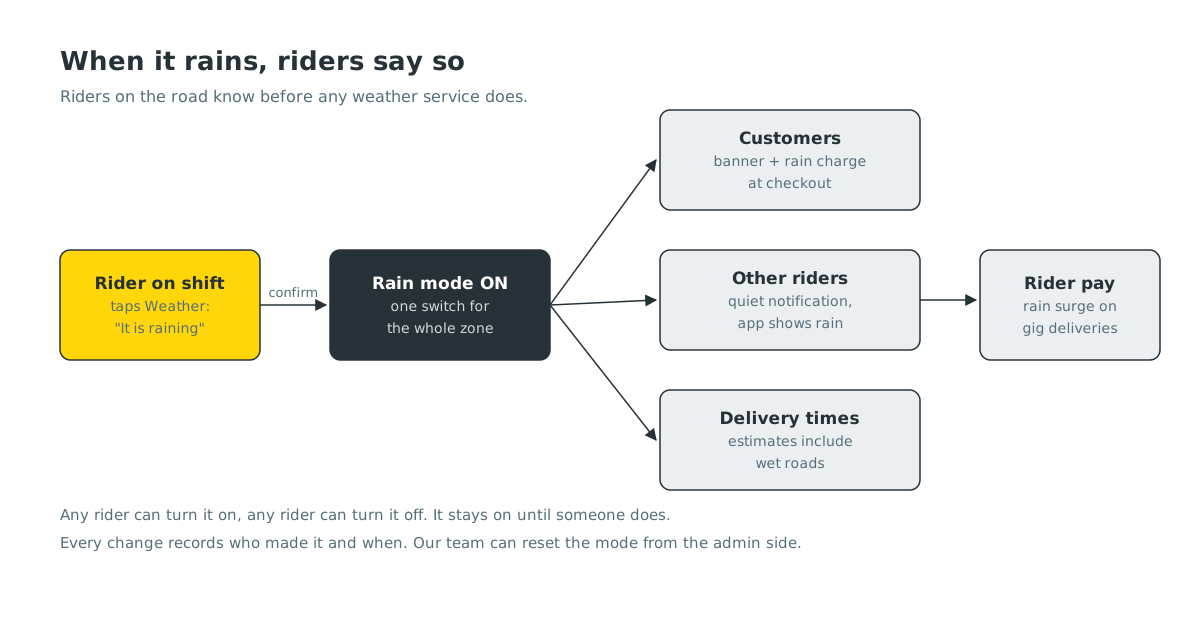
We kept the rules deliberately simple. There is one rain switch for the zone, not a vote. It stays on until a rider turns it off. Our team can still change the setting from the admin side, and whenever they switch the mode, the rain state resets so an old “it’s raining” from days ago can never linger.
What rain does to delivery time#
Rain does not slow everything down by the same amount. Kitchens cook at roughly the same speed. What changes is the road: riders go slower on wet tarmac, some lanes flood, and everyone takes a little more care at junctions.
Our delivery time estimates are learned from real past deliveries. Each order remembers whether it was placed in rain mode, and the model that predicts delivery times uses that as one of its signals, alongside things like the time of day, how busy the kitchen is and the road distance. When rain mode is on, the time you see on a restaurant card already includes the extra minutes rain tends to add.
That matters more than it sounds. A delivery app that promises 25 minutes in a downpour and arrives in 45 has not just been late, it has broken a promise. A realistic 40 minutes that arrives in 38 feels good. In the monsoon, honest beats fast.
Keeping riders safe#
No order is worth an accident. A few things we ask of everyone during heavy rain:
- Customers: please be patient, pin your location carefully, and keep your phone nearby so your rider can call if a lane is flooded.
- Riders: slow down, avoid flooded stretches even if the map says they are shorter, and keep your phone dry. If conditions become dangerous, stop and tell us from the app.
- Restaurants: pack food so it survives a wet ride, with lids sealed and bags closed.
Riders on gigs earn rain surge on deliveries made in rain mode, so going out in bad weather is recognised in their pay, not just in our thanks.
What we learned#
The rain switch taught us something that applies well beyond weather. The best signal is often a person who is already there. Our riders spend all day on the roads of Birtamod and Damak. They know when a road is blocked, when a market is closed and when the rain has started. Giving them a simple, trusted way to tell the system has made Laayo more accurate than any outside data source we tried.
So the next time it pours and your app quietly updates to show rain mode, there is a good chance it was a rider who flipped the switch, standing under a shop awning, before heading back out with your dinner.


