
We started small on purpose
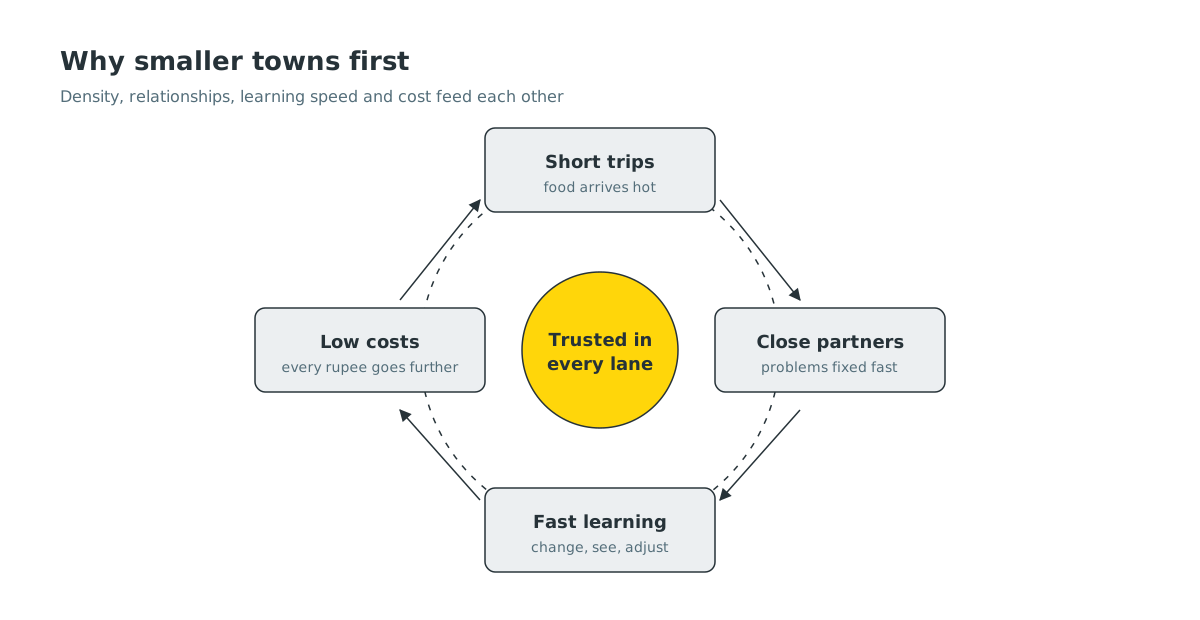
Launching in smaller towns first was not a compromise. Density, close partner relationships and low costs give a young company advantages that are hard to get anywhere else.

The standard playbook for a delivery company is to launch in the biggest city first. The logic is simple: that is where the most restaurants, customers and money are.
We went the other way. Laayo launched in Birtamod and then Damak, two growing towns in eastern Nepal. People sometimes assume that was because we could not afford a big city. The truth is that we chose it, and we would choose it again. Here is why.
Density makes the economics work#
Delivery is a game of density. What matters is not how many people live in a city, but how many orders a rider can complete in an hour, how far food travels and how long it waits.
In our towns, most deliveries are short. Restaurants, offices and homes sit close together. A rider can finish more trips in a shift, food arrives hotter and fewer orders are lost to long distances. Within a town, a small team can reach meaningful coverage quickly, instead of being one of many options spread thin across a huge city.
That density is also what makes each improvement count. When we make delivery estimates more accurate or cut the time food waits at the counter, the effect shows up across the whole town at once.
Relationships are close#
In a smaller town, we know our partners. Restaurant owners can call us. Our team can visit a kitchen the same afternoon a problem shows up. When a partner has a slow week, we notice and we talk about it.
These relationships are an advantage that is very hard to copy. A large platform arriving later can match our features, but it cannot easily match years of trust built face to face. Partners who feel heard tend to stay, and partners who stay improve their food, their packaging and their timing with us.
We learn faster#
A smaller market is a better laboratory. We can change something on Monday and see its effect across the whole town by Friday. We can talk to the riders who were on the road and the customers who complained, often in person.
Much of what is on this blog came from that loop: honest delivery estimates, typed cancel reasons that tell us what really happened, rider alerts that are hard to miss. Each started as something we saw on the streets of our own town.
Local knowledge shapes the product#
Building for smaller towns forced us to solve problems that city-first apps often ignore.
- Addresses are landmarks. Many homes have no usable street address, so customers drop a precise pin and riders can call when a lane is hard to find.
- Weather changes everything. Monsoon rain turns short rides into long ones, so our estimates and rider pay account for it.
- Cash and E-Payment live side by side. We support both and work to make every payment method feel like one tap.
- Lunch is the big moment. Offices, shops and schools all order at once, so a lot of our work is about getting the midday rush right.
These are not small-town quirks. They are common across much of Nepal, which means the product we built here travels well.
Costs stay low#
Operating in smaller towns is simply less expensive. Office space, marketing and operations cost less, and a small team can cover a whole town. Combined with lean engineering choices, which we describe in building lean, that means every rupee goes further while we are still learning.
Small is a starting point, not a ceiling#
Starting small does not mean thinking small. It means earning the right to grow.
Our playbook for a new town is now clear: sign the restaurants people already love, build a reliable rider team, get delivery times honest and fast, and earn trust one order at a time. Each town we serve makes the next one easier, because the product, the tools and the lessons come with us.
Our focus today is to make Laayo genuinely excellent in Birtamod and Damak. Beyond that, Kathmandu is the next city we are preparing for. We will only launch there when we are confident we can bring the same care. You can read more about our plans in what comes next.
We started small on purpose. We intend to grow on purpose too.


