
Why we are building Laayo
A letter from the people building Laayo. The gap we see in Nepal's smaller towns, what we are building to close it, and the beliefs that shape every decision we make.

Every company should be able to explain why it exists in plain sentences. Here are ours.
Most of Nepal does not live in Kathmandu. It lives in towns like Birtamod and Damak: busy, growing places with good restaurants, crowded bazaars, schools, offices and families who own smartphones and pay with QR codes every day. Yet the digital services that make city life easier usually arrive in these towns last, if they arrive at all, and when they do, they arrive built for somewhere else.
Laayo is our answer to that. We are building the everyday commerce layer for Nepal’s smaller towns, starting with the thing people do most often: ordering food.
The problem we saw#
Before Laayo, getting food delivered in our towns meant calling a restaurant, describing your house by the nearest temple or school, and hoping someone was free to bring it. Restaurants had loyal regulars but no simple way to reach new customers beyond their phone line and their front door. Young people who wanted flexible work had few options that paid fairly and predictably.
None of this was because people did not want something better. Smartphones are everywhere. Digital payments have become normal. The demand was there. What was missing was a service designed for how these towns actually work.
What Laayo is#
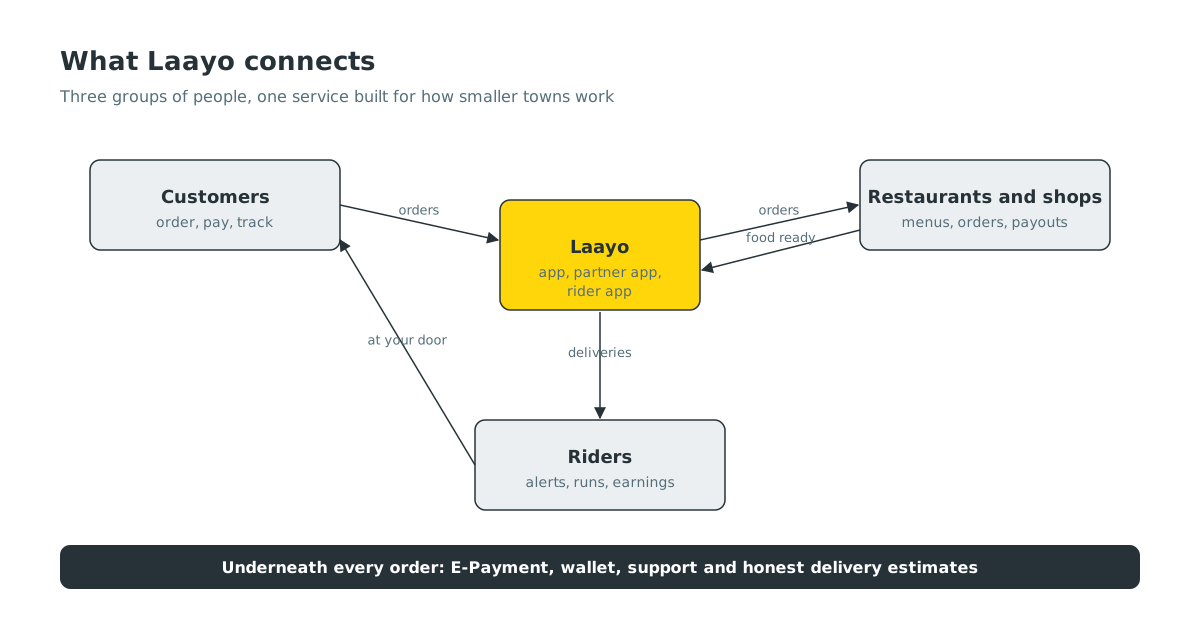
Laayo is a delivery app for food, groceries and everyday items, run by a local team, with a rider fleet that knows every lane in town. Around that core we have built the pieces a small town economy needs:
- The Laayo app for customers, with live tracking, E-Payment and a wallet.
- A partner app that lets restaurants and shops manage menus and orders and get paid on a regular schedule with clear statements.
- A rider app built around a rider’s real day: alerts that are hard to miss, a planner for multi-order runs and a transparent record of earnings and tips.
- Products for businesses beyond delivery, including Qora for QR payments and Laayo Biz, a point of sale for restaurants. We write about those in one company, four products.
What we believe#
These beliefs are not slogans. They are the reasons behind decisions we have already made.
Depth beats breadth. A great service in a few towns is worth more than an average one in many. We would rather be the app a whole town trusts than a logo in many towns that nobody loves. That is why we started small on purpose.
Local knowledge is an advantage, not a footnote. Knowing which roads flood in monsoon, which shops close early on festival days and how people actually describe their addresses shapes the product in ways no spreadsheet can. Our addresses are pins dropped on a map because many homes have no street address anyone uses. Our delivery estimates account for rain because rain is real here.
Trust is the product. In a small town, everyone talks. A late order, a cold meal or a payment that seems stuck is not a statistic, it is a conversation at the tea shop. So we invest heavily in the unglamorous parts: honest delivery times, clear payment status, support that reaches a real person and refunds you can follow.
Riders and partners are customers too. A delivery business only works if the people cooking and riding want to be part of it. Fair, predictable pay for riders and on-time payouts for restaurants are not costs we minimise, they are what keeps the whole system running.
Build lean, build well. We are a small team, so every engineering choice has to earn its place. We run a well understood core, measure before we optimise and only replace what is actually slow. We explain this in building lean and in our tech stack series.
Why now#
Several things have come together recently. Smartphones are now the default in our towns, not the exception. QR and wallet payments have become everyday habits, so paying a stranger on a phone no longer feels risky. And a generation of young people wants work that fits around study, family and farming seasons.
Those shifts make a service like Laayo possible in places where it would not have worked before. They also mean that whoever builds the most trusted service in these towns now will be very hard to dislodge later.
What we want to be#
Over time we want Laayo to be the first app people in Nepal’s growing towns open when they need something: a meal, groceries, a way to pay, a way to run their shop. We want restaurants to see Laayo as the partner that helped them grow. We want riders to see it as work they are proud of.
We are not there yet. We write openly on this blog about what works and what we are still fixing, because we think honesty is the only way to build something that lasts.
Thank you for reading, and for your interest in what we are building. If you would like to talk with us about Laayo, our investors page is the best place to start.


