
Building lean: how engineering choices stretch every rupee
A small team running several products has to be careful with money and time. The engineering habits that keep our costs low without cutting corners on reliability.

Capital efficiency is usually discussed in terms of marketing spend and headcount. For a technology company, engineering choices matter just as much. The wrong architecture can quietly eat money every month through cloud bills, third-party fees and the people needed to keep it running.
We are a small team running a delivery marketplace, a membership, a payment platform and a point of sale. That only works because of a handful of deliberate choices. This post explains them for readers who are less interested in code and more interested in how the business stays efficient.
Keep the core boring#
At the heart of Laayo is one well understood application that owns the business rules: orders, payments, payouts, support and the admin tools. We chose proven, widely used technology on purpose.
Boring technology is cheap to run, easy to hire for and quick to debug. It means our engineers spend their time on features customers notice rather than on keeping an exotic system alive. We explain the details in part one of our tech stack series.
Replace only what is slow#
When parts of the app needed to be faster, we did not rewrite everything. We measured which requests were used most and which were slowest, then rebuilt only those in Go, a fast and efficient language, while the rest stayed as they were.
The new code runs in the shadow first, comparing its answers with the old code before it is trusted. If anything looks wrong, the old path answers instead. That approach gave us large speed gains on the busiest screens without a risky big-bang rewrite. You can read how in part two of the series.
Pay for value, not for convenience#
Third-party services are useful, but their bills grow with usage. We review what we pay for and ask whether each cost buys real value.
One example: we found a single screen in the rider app that was asking a maps service for far more information than it used, and paying for all of it. Fixing it cut that cost dramatically without changing anything riders saw. The story is in cutting maps costs.
The same habit applies elsewhere. We convert images to modern formats so they load faster and cost less to serve. We cache answers that do not change often. We reuse what we have already built across products.
Own the tools that matter#
For monitoring and crash reporting, we run well established open source tools ourselves rather than paying per event to a hosted service. That gives us detailed visibility into every service and app at a predictable cost. It also means we see problems early, which is the cheapest time to fix them. Part five of the series shows what we watch.
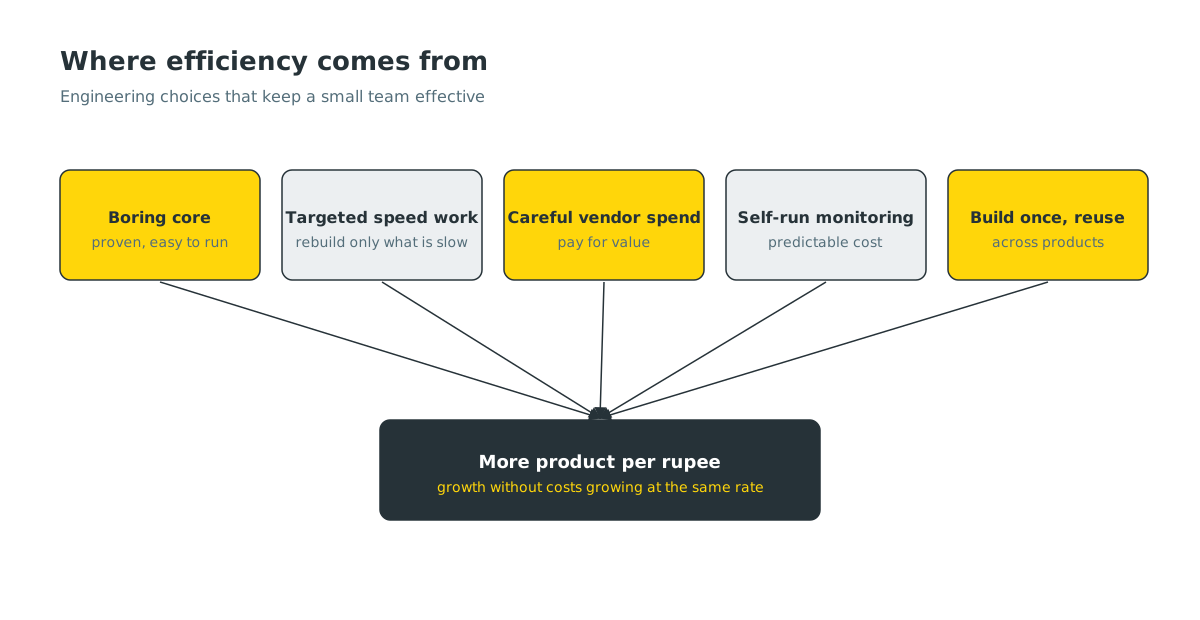
Build once, use many times#
Many of our tools serve more than one product. The payment handling we built for the Laayo app became the foundation for Qora. The billing flow serves both Qora and Laayo Biz. The same deploy scripts, monitoring and security practices protect every product.
Every time we reuse something instead of building it twice, we save not just the build but years of maintenance.
Habits that prevent expensive mistakes#
The most expensive engineering work is fixing something that broke in production. So we invest in habits that catch problems early:
- Test first, in a separate environment. Every change is built and checked away from real customers before it ships.
- Ship with a way back. Production changes go out through scripts that take a backup first, and every change comes with a way to undo it.
- Switch things off, not just on. New features can usually be turned off in seconds without a new release.
- Think about security while building. Each new feature is checked for the ways it could be misused before it goes live, not after.
None of these are glamorous. Together they mean fewer late nights, fewer refunds and less time spent on repairs instead of progress.
Small team, high leverage#
We do not measure ourselves by team size. We measure by what each person can ship and keep running. Clear ownership, good tooling and careful choices let a small team do work that would otherwise need a much larger one.
That leverage matters for investors and partners because it means growth does not require costs to grow at the same rate. As we add towns and products, most of the platform comes with us already built, already monitored and already paid for.
For the full technical picture, start with the tech stack overview.


