
How we measure progress
The signals our leadership team watches closely, why we chose them over vanity numbers, and how each one connects to a decision we can actually make.

It is easy to measure a delivery business by the biggest numbers it can find. Those numbers feel good, but on their own they say little about whether the business is healthy or whether customers will come back next week.
We prefer signals that tell us something we can act on. This post explains which ones we watch and why. We do not share the values here. The point is the thinking behind them.
Customers: do they come back?#
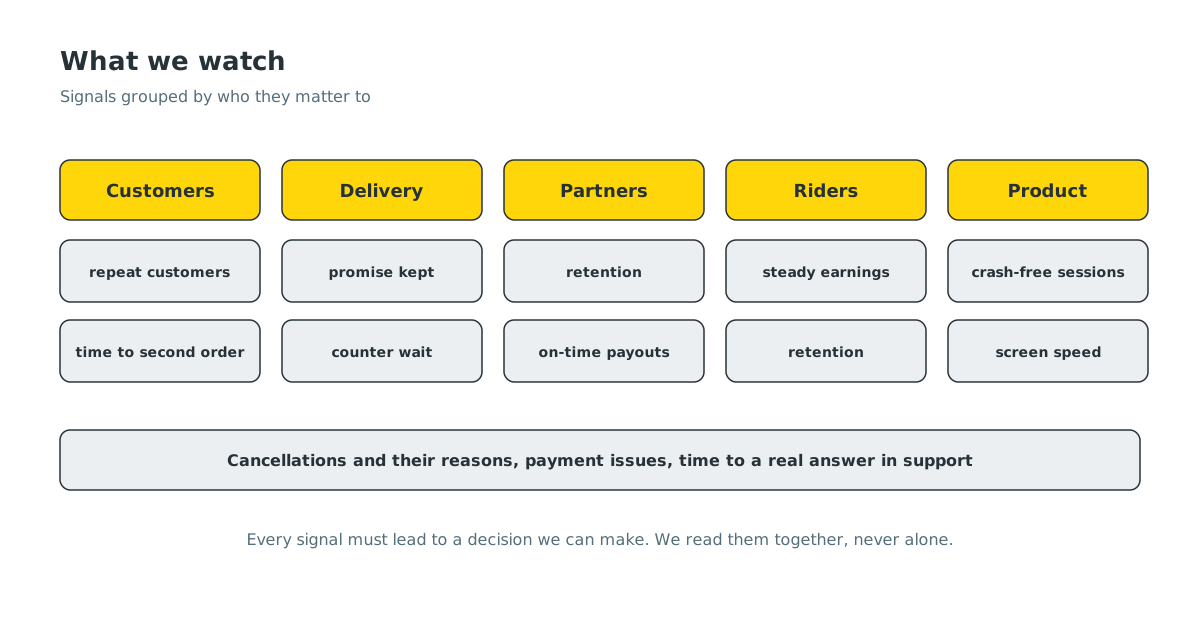
Repeat customers. The most important question for any consumer business is whether people come back. A customer who orders a second and third time has decided Laayo is worth it. We watch how many customers return, how soon and what happened on the orders before they stopped.
Time to second order. The gap between a customer’s first and second order tells us how well their first experience went. A long gap or no second order is a signal to look closely at what went wrong.
Delivery: did we keep our promise?#
Delivery time accuracy. We care less about how fast the average delivery is and more about how often we arrive within the time we promised. A customer whose food arrives when we said it would is happier than one who was promised something quicker and kept waiting. We explain our estimates in how we estimate delivery time.
Time food waits at the counter. Much of the delay in a delivery is not the ride but the wait between food being ready and a rider picking it up. This is where we look for the biggest improvements.
Cancellations: why did it go wrong?#
Cancellations and their reasons. Every cancelled order is a broken promise to someone. We track how many orders are cancelled and, more importantly, why. That is why we moved from preset reasons to typed cancel reasons: a real sentence from a rider or customer tells us what to fix far better than a tick box.
Partners: are restaurants better off with us?#
Partner retention. Restaurants and shops that stay with us, and grow with us, are the best evidence that Laayo works for them. We watch which partners stay active, which slow down and what we can do about it.
Payout reliability. Partners should be paid on time with a statement they can trust. Late or confusing payouts damage relationships faster than almost anything else, so we watch them closely.
Riders: is the work worth doing?#
Rider earnings stability. Riders need predictable income. We watch whether earnings are steady and fair across shifts and seasons, not just whether a few riders do well.
Rider retention. Experienced riders know the town, deliver faster and take better care of orders. Keeping them is both a matter of fairness and good business.
Payments: is paying easy?#
Digital payment share. We watch how many orders are paid by E-Payment or wallet rather than cash. A rising share means payments feel easy and safe, which reduces cash handling for riders and speeds up payouts for partners.
Payment issues. Any payment that leaves a customer unsure whether they paid is a problem. We track how often that happens and how quickly it is resolved.
Product: does the app just work?#
Crash-free sessions. An app that crashes loses trust instantly. We track crashes on every app and treat a new crash as urgent. Our monitoring is described in part five of our tech stack series.
Speed of key screens. How quickly the app opens and how fast the home screen and menus load shape every customer’s first impression. We measure response times on our busiest requests continuously.
Support: do problems get solved?#
Time to a real answer. When something goes wrong, how long does it take a customer, partner or rider to reach someone who can fix it? We watch how long that takes and how often the first answer actually solves the problem.
Why these and not others#
Each signal on this list connects to a decision we can make: change how orders are offered to riders, work with a partner on packaging, fix a screen that is slow, adjust how support hands over to staff. If a number does not lead to an action, we do not spend much time on it.
We also look at signals together rather than alone. Growth that comes with rising cancellations is not progress. Faster deliveries that come from overworked riders are not progress either. Real progress shows up across the whole list at the same time.
These signals keep us honest with ourselves. We believe they are also the right way for anyone interested in Laayo to judge how we are doing. If you would like to talk with us, visit our investors page.


