
Getting paid, and knowing you have been paid
For a restaurant, a payout is only real when the money is in the account and the owner knows why it is that amount. How we tell partners about every payout by text, email, a clear statement and a quick phone call.

When a restaurant joins Laayo, it trusts us with something important: the money its customers pay for its food. Customers pay us by cash at the door or by E-Payment, and we pass the restaurant’s share on to them. How well we do that, and how clearly we explain it, decides whether a partner stays with us for years or quietly drifts away.
This year we rebuilt the way partners hear about their payouts. The money was always being sent. What was missing was the feeling of certainty that it had arrived, and an easy way to understand the amount.
How payouts work#
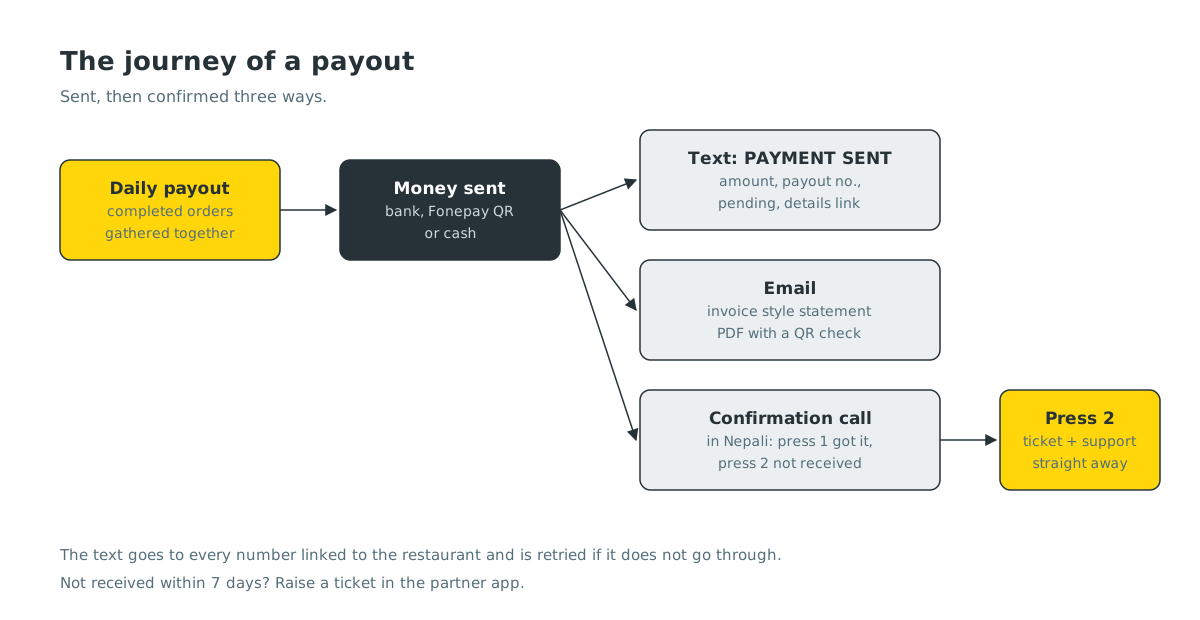
Every day, the orders a restaurant has completed are gathered into a payout. Each payout is a list of orders with, for each one, the food value, any discount the restaurant chose to fund, the commission and what the restaurant receives.
Partners choose how they want to be paid when they sign up: a bank transfer to their account, a Fonepay QR, or in some cases cash handed over by our team. Whichever way it goes, the moment a payout is marked as paid, the restaurant hears about it.
A text that reads like good news#
The first thing a partner gets is a text message. We rewrote it more than once, because the first version read like a bill. Owners would see “Laayo” and an amount and assume they owed us money.
The message now starts with the words that matter: PAYMENT SENT. It says that Laayo has paid the restaurant for its Laayo orders, how much, and the payout number they can match in the partner app. If more payouts are still on their way, it says how much is pending. And it ends with a short link to the full details.
A few details we were careful about:
- Everyone who needs to know, hears. The text goes to every number linked to the restaurant: the owner, the shop line, the preferred contact and active staff. Duplicates are removed, so nobody gets the same text twice.
- One message for a batch. When several payouts are sent at once, the restaurant gets one text with the total, not a pile of separate ones.
- It keeps trying. If a text does not go through, it is retried automatically for a while, so a busy network on payout day does not mean a partner never hears.
- Partners can opt out. Some restaurants prefer not to get these messages. They can turn them off, and we respect that.
A statement anyone can read#
Accountants love a ledger. Restaurant owners in Birtamod, understandably, mostly do not. Our first statement was accurate and complete, and almost nobody outside our finance team could follow it.
So the link in the text now opens a statement that looks like an invoice from the customer app. It shows:
- the restaurant’s name, address and PAN,
- the payout number and date, in both the Gregorian and Bikram Sambat calendars,
- how it was paid,
- a simple table: each order, its value, any discount, the commission, and the column partners care about most, You get.
Every statement carries a QR code. Scan it, and our verification page confirms that the document really came from Laayo. That matters when a partner hands a statement to their own accountant or a bank.
The same statement is also sent by email as a PDF, so partners who keep their records on a computer have a copy without asking.
For partners who do want every detail, our team can produce a full statement covering many payouts at once: the money trail from the menu price down to the amount transferred, a summary of items sold and every order with its line items.
A call to make sure#
A text can be missed. An email can sit unread. And sometimes, rarely, a bank transfer takes longer than it should. We did not want a partner to discover a missing payment a week later, after it had already become a worry.
So after the text goes out, the restaurant also gets a short automated call. In Nepali, it tells them the amount that has been paid and asks a simple question:
- Press 1 if you have received it.
- Press 2 if you have not.
If the owner presses 2, a support ticket is raised straight away, our team is alerted, and the call is put through to someone who can help. If the owner is busy and cannot check right now, they can simply call Laayo back later, and the same question is waiting for them.
We learned one small lesson building this. The call reads the amount out loud, and the first version read numbers digit by digit, which sounded strange. Amounts are now spoken as words, the way a person would say them.
What we hope partners feel#
None of these pieces are complicated on their own. A text, an email, a readable statement, a short call. Together they change how a payout feels: from “I think the money came, I should check” to “I know it came, and I know why it is that amount”.
If you are a Laayo partner and anything about a payout does not look right, do not wait. Raise a ticket in the partner app within seven days of the payout, or press 2 when we call. We would always rather fix it on day one.


