
Joining Laayo as a restaurant partner, rebuilt from the counter up
Signing up a restaurant used to mean a long form and a lot of back and forth. We rebuilt it as eight short steps that ask the questions we would ask in person, with samples for every photo and document.

Most of the restaurants on Laayo were signed up the same way: someone from our team stood at the counter, chatted with the owner between orders, and filled in the details together. That works, and it is still one of our favourite parts of the job. But it does not scale, and it does not help the restaurant owner who hears about Laayo from a friend at ten at night and wants to apply right then.
So we rebuilt the Partner with Laayo sign-up in the customer app around a simple idea: ask the same questions we would ask at the counter, in the same order, in plain words.
Eight short steps#
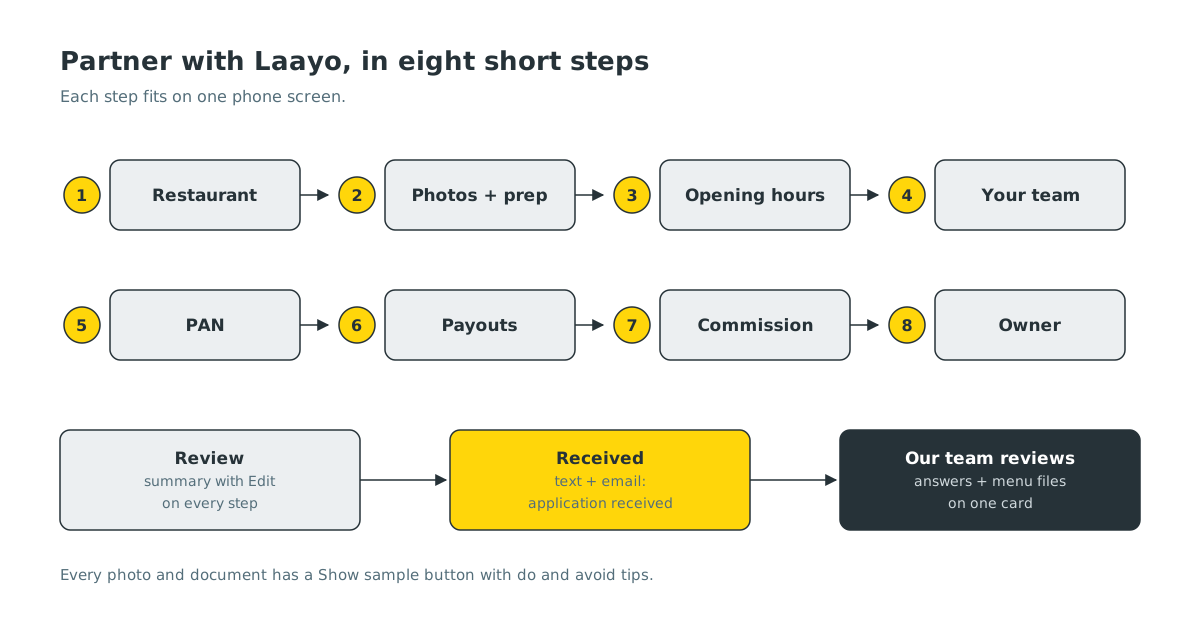
The new sign-up is split into eight steps. Each one fits on a phone screen and can be finished in a minute or two.
- Your restaurant. Name, address, whether you serve veg, non-veg or both, and a pin on the map. The pin works exactly like choosing a delivery address in the app, with search and nearby places, so you can drop it right on your door.
- Photos and preparation time. A cover photo, a logo, a few photos of the shop and your menu. We also ask how long a typical order takes to prepare. You tell us the kitchen time, and we add a fixed allowance for the ride, because delivery is on us.
- Opening hours. The same hours every day, or different hours for each day. Late night kitchens can set hours that run past midnight.
- Your team. Who works at the shop and the numbers riders should call when they arrive, so the rider is not left ringing the owner’s personal phone during service.
- PAN. Your PAN or VAT certificate. Nepal PAN does not expire, so we no longer ask for an expiry date.
- Payouts. Where you want to be paid: pick your bank from the full list of banks, add a Fonepay QR, or both. You can also choose to add this later.
- Commission. The commission you are comfortable offering. It is a starting point for a conversation, not a final contract.
- The owner. Your name and contact details.
At the end you see a summary of everything, with an Edit button on each section, and then a short “what happens next” screen so you are never left wondering.
Samples for everything#
The most common reason an application stalled used to be a photo. A blurry menu, a PAN certificate photographed at an angle, a cover photo that was actually a poster.
So next to every upload there is now a Show sample button. It shows what a good photo looks like and a short list of do’s and don’ts:
- Cover and logo samples show how they will actually appear in the Laayo app, next to real dishes.
- Shop photos show a clear counter, kitchen and seating area.
- Menu samples show a flat, well lit page you can read from edge to edge.
- PAN certificate and Fonepay QR samples are clearly stamped SAMPLE, so nobody uploads the example by mistake.
For owners who prefer to watch rather than read, the first screen also links to a short video that walks through the application.
Small details that mattered#
Some of the changes were tiny, and still made a real difference:
- The keyboard opens on letters. On iPhones, one of our name fields used to open the number pad. It now opens the normal keyboard everywhere in the app.
- Leaving is safe. If you start the form and tap back, a friendly sheet asks whether you want to keep going or leave, instead of quietly losing your progress.
- Menus can be files. If your menu is a PDF or a set of pictures, you can upload those directly.
- Packaging charges are asked up front. If you charge extra for packaging, once per order or per item, you can tell us during sign-up rather than finding out later that it was never set.
What happens after you apply#
As soon as you submit, you get a text message and an email confirming that we have received your application. We were careful with the wording here. An earlier message said something close to “you’re all set”, which made some owners think they were already live. The new message says clearly that the application has been received and that our team will be in touch.
On our side, the application lands in a review queue with all of your answers on one card: how many menu files you sent, whether opening hours and payouts are set, and how many staff you added. Your menu files are filed straight into your restaurant’s documents, so our team can start setting up your menu without asking you to send them again on chat.
Signing up in person still works#
Our field team still visits restaurants, and they now carry the same flow in the Laayo admin app. They stand at your door, the location comes from their phone’s GPS, and they can create your account on the spot. The app even generates a strong password with a copy button, so nobody has to invent one at a busy counter.
One rule we care about: before anyone types a word, the form says what the button will do. Depending on the person’s role, a restaurant either goes live straight away or is sent to the office for approval. Those are different promises to make to an owner, and it is only fair that our team knows which one they are making before they make it.
Rolling out#
The new sign-up is rolling out with the latest version of the customer app, and our team is already reviewing applications through the new queue. If you run a restaurant or shop in Birtamod or Damak and want to reach more customers, open the Laayo app, tap Partner with Laayo, and give it ten minutes. If you get stuck on any step, the samples are there, and so are we.


