
Help when you need it, and a person when it matters
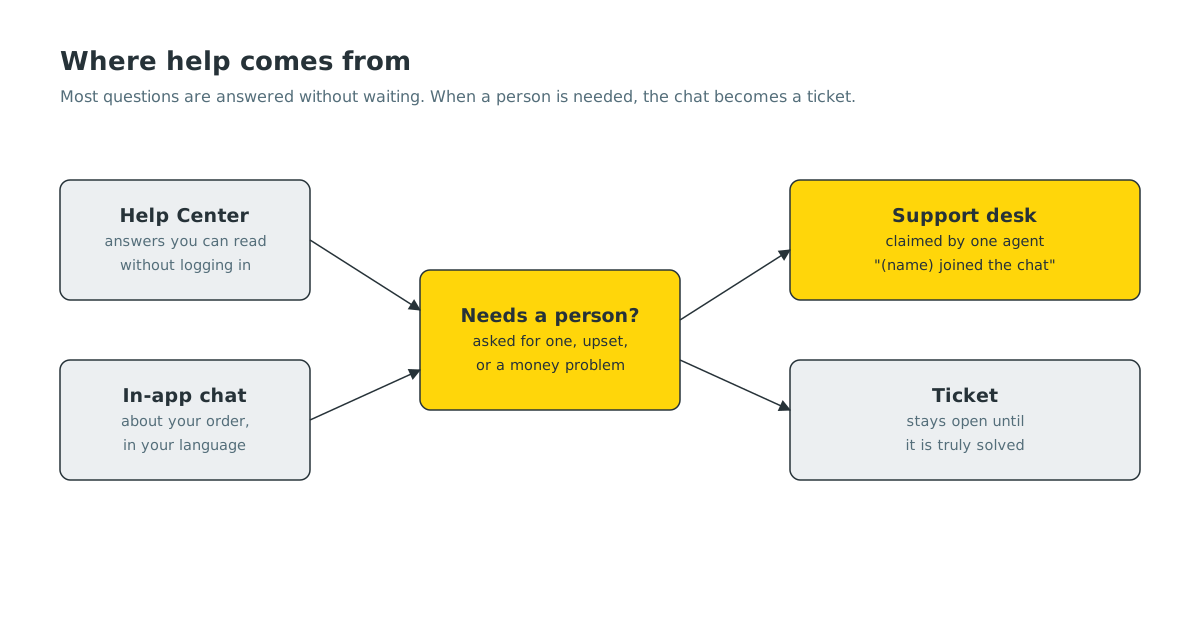
Our Help Center answers the common questions before you have to ask. When you do need someone, the chat should go to one person who owns it until it is solved. Here is how we built both.

Most questions people bring to support are not emergencies. How do I change my address? Why was I charged a delivery fee? How long does a refund take? Those deserve a clear answer you can read in a minute, at any hour, without waiting for anyone.
A few questions are different. The food arrived cold and half of it was missing. Money left your account and the order did not go through. For those, you should reach a person, that person should stay with you, and the problem should not quietly disappear when the chat goes quiet.
This post is about building for both.
A Help Center you can actually read#
support.laayo.com.np is our public Help Center. It is organised by topic, ordering, payments and refunds, your account, riders and restaurant partners, with short articles written in plain language. Every article ends with “Was this helpful?” so we can see which answers are not working and rewrite them.
A few principles we held to:
- Only describe what is live. If a feature is still rolling out, the Help Center does not promise it. A help article that describes a button you cannot find is worse than no article.
- Same words as the app. If the app says “E-Payment”, the Help Center says “E-Payment”.
- Editable without a release. Our support team can update articles from the admin panel, so a confusing answer can be fixed the same day.
We are also rolling out sign in with your Laayo account on the Help Center, so you can see your recent orders, your open reports and your chats with us in one place, from any browser.
Chats used to have no ending#
Support chat in the Laayo app is one long conversation per customer. That is nice for the customer, who can scroll back and see everything. It was bad for us. Our team had no clean way to tell “this person needs a reply right now” from “this person said thanks three days ago”. Almost every conversation looked like it was waiting.
So we split the long conversation into sessions. A session is one stretch of help: it starts when you write in, it can be waiting, active or resolved, and it ends when the problem is sorted. “Needs reply” now means one thing: a session where the customer is waiting and nobody has answered.
One person owns the conversation#
When a chat needs a person, someone on our team claims it. The customer sees “(name) joined the chat”, with the agent’s first name, so they know a real person is reading. If that person needs to hand over, for example to someone who handles refunds, the chat is transferred and the customer sees the new name join.
A few small rules make this feel human:
- No vanishing history. Resolving a session never hides earlier messages from the customer.
- Notes stay internal. Agents can leave notes for each other on a chat. Those notes live separately and can never be shown to the customer by mistake.
- Rating is just a reply. When a session ends, we ask how it went. You can answer with a number or a few stars, right in the chat. No new screen, no app update needed.
The new support desk is rolling out to our operations app, and our team is already using it as it arrives.
When a chat becomes a ticket#
Some problems take longer than one conversation. A refund needs a payment check. A missing item needs the restaurant to confirm. Before, those problems lived only in someone’s memory, and if that person went home, the customer waited.
Now, a chat that needs a person becomes a ticket automatically. A ticket is not a second conversation, it is a view onto the same chat, so replies still go to the customer where they already are. The ticket stays open until it is truly resolved, even if the chat goes quiet, and it sits in the same queue as order problems reported from the app, sorted by who has waited longest.
Tickets open for clear reasons: the customer asked for a person, the problem is about money, or the assistant promised to check something. When the only signal is a word, like someone writing “worst”, the assistant reads the conversation first. A joke about the “worst” momo craving does not become a ticket. A message saying a rider took cash and the order never arrived does.
Each ticket gets a short subject and summary, so the person who opens it understands the problem in seconds instead of scrolling through the whole chat.
What’s next#
We want the first answer to be right more often, so fewer people need a person at all. That means better Help Center articles, written from the questions we actually receive. And for the people who do need us, we want the wait to be short and the ending to be clear. If you ever feel a support chat was closed before your problem was solved, reply in the same chat and we will pick it up again.


